
MISUMI offers a wide selection of shaft couplings to provide solutions for different industrial needs, focusing on providing efficient torque transmission, compensating for misalignment and protecting against overloads and equipment damage..
Couplings
A coupling is a mechanical component used to join two shafts or parts of a machine in order to transmit power. Its main function is to allow connection between two shafts that may be misaligned or may have different movements. This helps prevent the transmission of vibrations and shocks between the connected parts, which can damage machinery.
Couplings are commonly used in conveyor drive shafts, actuator motor mounts, food processing equipment, lab automation, packaging and paper processing, 3D printers.
There are three main functions for the use of a coupling:
- Join different shafts and transmitting torque
- To compensate for misalignment
- To protect systems against excessive torque
In our online store you will find a wide variety of types, both rigid and flexible, available from MISUMI, NBK, R+W, Miki Pulley, among others.
Shaft Misalignment

Angular misalignment: when shafts are not on the same plane and there is a parallelism error between the two shaft centers measurable by an angle.

Lateral misalignment: when the shafts are not centered to each other or the angular error between two shaft centers.

Axial misalignment: when shafts shift in the axial direction.
Coupling Types
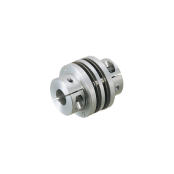
Disk
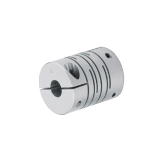
With Slit
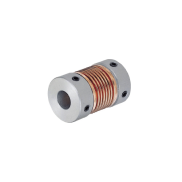
Bellow
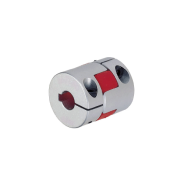
Jaw
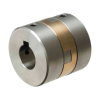
Oldham
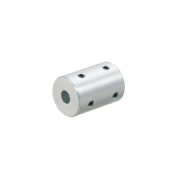
Rigid
Guide for selecting coupling
When selecting a coupling it is important to consider the following 6 characteristics based on its application:
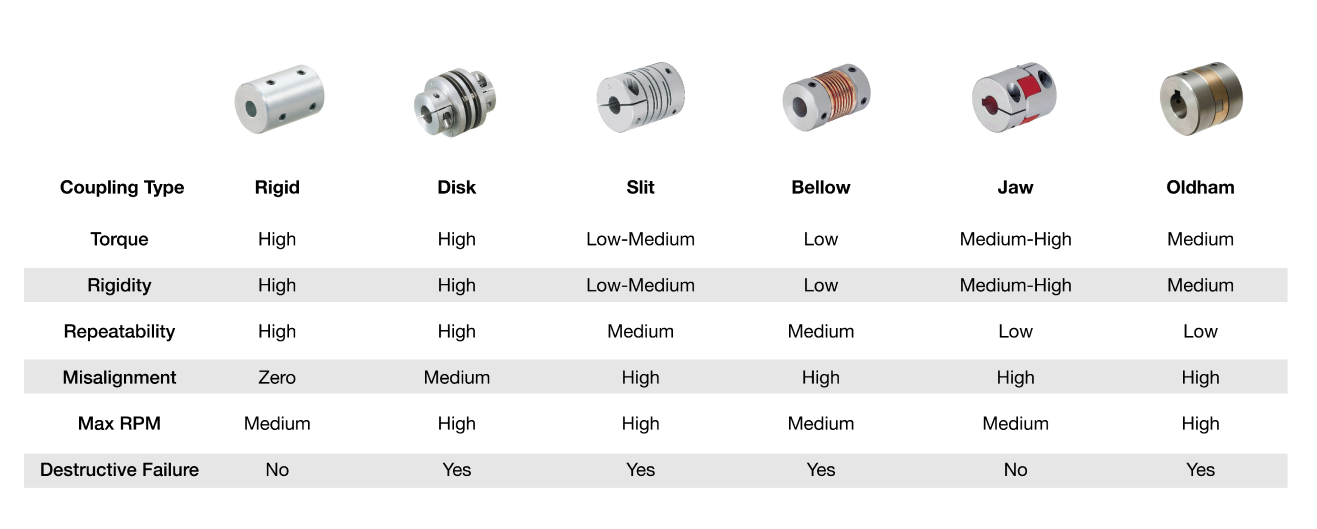
Applications
Knowing the ideal applications for each coupling helps you to choose the most suitable option for your requirements.
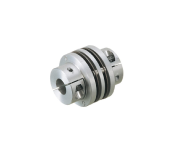
Our most popular
Servo/Stepper Motor application
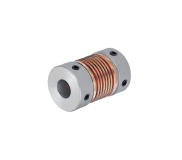
Low torque applications that requieres high repeatability.
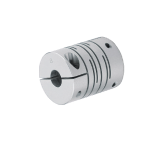
Servo/Stepper Motor application
But NO misalignment tolerances allowed
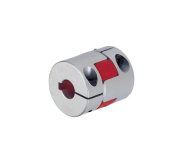
Conveyor systems
Applications that requires unidirectional rotation.
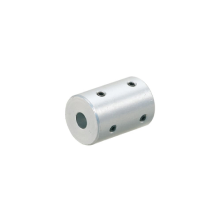
Servo/Stepper Motor applications
High misalignment tolerance but shorten life
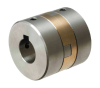
Interchangeable spacer
Can fail at spacer
Large lateral misalignments
Special couplings
MISUMI also offers a wide variety of special couplings, which provide high torque, large angular misalignments, among other features.
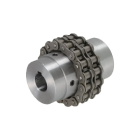
Chain Coupling
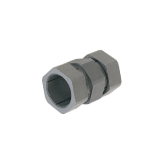
N-coupling
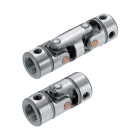
Universal coupling
Very high torque,
low RPM
High torque,
allows thrust load, tapered lock
Large angular misalignments
~30deg
Shaft Connection Methods
The most common shaft connections used with a coupling are:

Set screws: the shaft is connected to the coupling by bolts, normally one or two are placed at 90 degrees apart.

Clamp style: the shaft is attached to the coupling by a clamp that fits around the shaft and is tightened to lock it into place. It is common in applications where frequent system changes are required or where a more flexible solution is sought.
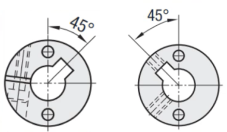
Keyway: the shaft is connected to the coupling by a keyway, which is a prismatic piece that is inserted into a keyway machined in the shaft and coupling hub. This method provides a solid and precise connection, ideal for applications involving high loads or torques.
Q&A
1. What is the tolerance on the coupling bores?
MISUMI brand couplings have an H8 bore tolerances unless otherwise specified. For clamping styles, this tolerance is before the slit is cut.
2. Can the spacer or spider be purchased separately?
MISUMI brand plastic spacers for oldham style couplings and R+W spiders for jaw style couplings can be found on our website. MISUMI brand spiders for jaw couplings may be available by request. Please contact Technical Support for part number information.
3. Can you combine inch and metric bores on the same coupling?
MISUMI offers a limited selection of couplings that offer both inch and metric bores on the same part. R+W can provide inch/metric bore combinations by request. Please contact Technical Support for more information.
Technical Support
Tel: +52 442 672 7661 Ext. 2, then wait and dial 4
E-mail: soportetecnico@misumimex.com
Mon.-Fri. 8 a.m. – 6 p.m.