(!)Due to Microsoft's end of support for Internet Explorer 11 on 15/06/2022, this site does not support the recommended environment.
Mon. - Fri. 8 a.m. - 6 p.m.
All Categories
-
Automation Components
Automation Components
Show all categories of Automation Components-
Linear Motion
-
Rotary Motion
-
Connecting Parts
-
Rotary Power Transmission
-
Motors
-
Conveyors & Material Handling
-
Locating, Positioning, Jigs & Fixtures
-
Inspection
-
Sensors, Switches
-
Pneumatics, Hydraulics
-
Vacuum Components
-
Hydraulic Equipment
-
Spray Equipment And Accessories
-
Pipe, Tubes, Hoses & Fittings
-
Modules, Units
-
Heaters, Temperature Control
-
Aluminum Extrusions, Framing, Support & Posts
-
Casters, Leveling Mounts, Posts
-
Doors, Cabinet Hardware
-
Springs, Shock Absorbers
-
Adjustment/Fastening Components, Pins, Magnets
-
Antivibration, Soundproofing Materials, Safety Products
-
- Fasteners
- Materials
-
Wiring Components
Wiring Components
Show all categories of Wiring Components-
LAN Cables / Industrial Network Cables
-
Equipment Specific Cables
-
Cordsets
-
Computer & AV Cables
-
Wire/Cable
-
Connector (General Purpose)
-
Crimp Terminal Components
-
Cable Organization
-
Cable Gland Components
-
Cable Bushing/Clip/Sticker
-
Screw/Spacer
-
Cable accessories
-
Tube
-
Electrical Conduits
-
Duct/Wiring
-
Electrical Wiring Tools
-
Dedicated tools
-
Soldering supplies
-
- Electrical & Controls
-
Cutting Tools
Cutting Tools
Show all categories of Cutting Tools-
Carbide End Mill
-
HSS End Mill
-
Concrete Drill Bits
-
Milling Cutter Insert / Holder
-
Core Drill Bits
-
Customized Straight Blade End Mill
-
Dedicated Cutter
-
Crinkey Cutters
-
Turning Tool
-
Drill
-
Cutting Tool Accessories
-
Screw Hole Related Tools
-
Reamer
-
Electric Drill Bits
-
Chamfering, Centering Tool
-
Hole Saws
-
Magnetic Drill Press Cutters
-
Step Drills
-
Wood Drills & Cutters
-
-
Processing Tools
- Packing & Logistics Storage Supplies
- Safety Products
-
Research and Development & Cleanroom Supplies
Research and Development & Cleanroom Supplies
Show all categories of Research and Development & Cleanroom Supplies - Press Die Components
-
Plastic Mold Components
Plastic Mold Components
Show all categories of Plastic Mold Components-
Ejector Pins
-
Sleeves, Center Pins
-
Core Pins
-
Sprue bushings, Gates, and other components
-
Date Mark Inserts, Recycle Mark Inserts, Pins with Gas Vent
-
Undercut, Plates
-
Leader Components, Components for Ejector Space
-
Mold Opening Controllers
-
Cooling or Heating Components
-
Accessories, Others
-
Components of Large Mold, Die Casting
-
-
Injection Molding Components
Injection Molding Components
Show all categories of Injection Molding Components-
Purging Agent
-
Injection Molding Machine Products
-
Accessories of Equipment
-
Auxiliary Equipment
-
Air Nippers
-
Air Cylinders
-
Air Chuck for Runner
-
Chuck Board Components
-
Frames
-
Suction Components
-
Parallel Air Chuck
-
Special Air Chuck
-
Mold Maintenance
-
Heating Items
-
Heat Insulation Sheets
-
Couplers, Plugs, One-touch Joints
-
Tubes, Hoses, Peripheral Components
-


- Webcode Seach | Series
-
#CODE
- Discontinued Products
Loading...



Case Study: Custom Test Equipment OEM Uses One Vendor
CUSTOM TEST EQUIPMENT OEM USES ONE VENDOR
FOR NEARLY EVERY COMPONENT ON SEVERAL BUILDS
Realizes cost savings, time compression and innovative product applications
CUSTOM TEST EQUIPMENT OEM USES ONE VENDOR FOR NEARLY EVERY COMPONENT ON SEVERAL BUILDS
Phil Warga has always been the kind of engineer who believed in thinking outside the box, as the saying goes. Following a long career of 25 years in the automotive test equipment business at companies such as Forester Instruments in Pittsburgh, Phil opened Salem Design & Manufacturing in Salem, Ohio in 2004. Here, he and his engineering team design and build a variety of highly application-specific, custom machinery for the gauging and inspection of precision components. Typical measuring technologies employed here include eddy current, mechanical gauging, ultrasonic and laser vision inspection systems, along with other devices.
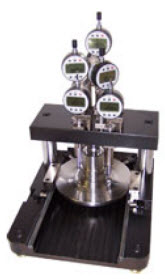
Salem Design & Manufacturing
design and build highly
application-specific, custom
machinery such as this
automotive spindle gauge.
Very near to the startup of his own company, Warga found a supplier that intrigued him, as a result of their unique business model. Thousands of mechanical and motion control components, so vital to the performance of Salem machines and systems, could be configured for a particular dimension, finish or other parameter then ordered in very small quantities, with no tooling or minimum order up charge. Thus began Salem's relationship with MISUMI USA, one that today sees these two companies in a symbiotic state, where the customer brings new applications for existing products to a vendor more than willing to adapt standard designs and material finishes meeting the requirement.
Salem primarily works with Tier II and Tier III suppliers to automotive, providing a bearing manufacturer, for example, a piece of equipment used to inspect a particular model year's components with extremely tight specifications. In addition, the company services the demanding needs of the nuclear fuel rod industry, as well as various producers of specialized bar, tube and wire products. Salem engineers obtain the specifications for the equipment then begin their design process, using SolidWorks 2008 as the primary mechanical design software and AutoCAD for the electrical and hydraulic/pneumatic design stages. As Warga explains, "We put the initial design up on a screen in the engineering department and everyone literally takes a look. This process is extremely valuable to our own business model, as it stimulates the thought process among our design, manufacturing and assembly people."
At this critical stage, the MISUMI catalog is close at hand. As Warga explains, "We often see products in the catalog which might serve an entirely new purpose in one of our machines." A Salem engineer, for example, recently devised a way to use a linear shaft support as a prox switch flag on a robotic gripper assembly. Working with the MISUMI application engineers, this alternate use was quickly confirmed as practical and the part was specified. This is not an unusual occurrence, according to Phil Warga. "These non-intended uses of their products are simply a matter of thinking in new ways. I admit it took some persuading to get our engineers onboard with the mindset, but once they began to see the possibilities, good old American ingenuity took over and the results have simply been amazing."
This engineering achievement complements the other benefits the company is realizing from its relationship with its vendor. Salem does its cost analysis on new machine builds in a very rigorous manner, according to the purchasing agent, Rachelle Brown, who noted that MISUMI prices for finished products often total half the available raw material cost from her local vendors. "Since we buy in such small quantities usually, to build just one or two machines, the cost to bring material into our shop, then machine and modify it, is nearly double the cost of a finished piece from this vendor." In certain instances, when all the machining time, labor and other factors are calculated, some parts would cost five to ten times as much, according to Brown. Warga also notes the material composition and finish, very critical elements in the overall merchantability of Salem machines, is superior. "We've received raw materials from local vendors that simply pale in comparison to what we get from MISUMI. From the grain of the materials to the coating such as nickel plating consistency and coloration, we've been extremely satisfied. Our machines have an enhanced aesthetic quality, as a result, and that's a very important part of making the sale, especially when it's a highly specialized system that will remain on a customer's production floor or in a test lab or even a clean room for a long time."
Salem manufacturing manager, Steve Kiki, added that even on most complex parts, where Salem does the machining in-house, the use of pre-machined blocks from MISUMI enables every part to be produced in 40% less time with half the material cost involved. "This is an area where the configurable nature of MISUMI parts presents a decided advantage. Since most of this vendor's parts are made to metric standards, while nearly all of Salem's machines are built to inch gauge, the vendor's willingness and ability to configure the parts to the customer's spec with no up charge represent a significant savings overall, both in material cost and machining time, as evidenced here at Salem," Kiki noted.
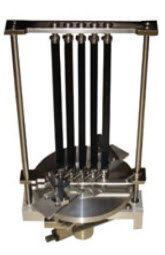
Salem's unique DXAL machine
was built for the National
Institute of Standards
and Technology
Warga anticipates further utilizing MISUMI products, especially as Salem seeks to penetrate the export test machine market, where the metric standards will make this vendor's standard products even more applicable and cost-effective for the builder.
Two Salem machine builds bear out the savings being realized at the company through its close relationship with its vendor. On the unique DXAL machine, built for the National Institute of Standards and Technology (NIST) and a device used in neutron research on a multi-axis crystal spectrometer, 95% of the part content was MISUMI pre-machined blocks and components.
On a brake cam gauging system, used for shaft rotating and testing of the brake cam follower that separates the brake shoes, rings of steel tubing are cut and the walls are inspected for length, perpendicularity of cut and other factors. Dozens of MISUMI components were specified for this unique, one-off machine. These included linear slides and ball bearings, plates, rails, guides, stages, rollers, shafts and shaft supports, among other components.
Obtaining more components through the vendor's online ordering system has also proven beneficial to Salem, as Warga notes, "Because the final prints and the steel can hit our assembly floor at almost the exact same time. Thus, we realize reduction in stocking area, component carrying costs and multiple vendor shipping challenges."
Finally, Salem calculates their revenue-per-employee and has determined their current status exceeds the industry norm by more than $100K per employee. "That's efficiency to the max," boasts Warga, noting how this cost advantage combines with his company's unique engineering talents to make it a formidable force in the test equipment industry.
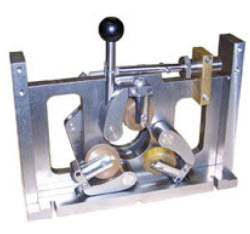
Working closely with MISUMI, Salem designed,
engineered and built an all stainless steel guide
roll stand using 100% MISUMI content.
One last piece of equipment stands as perhaps the best example of how this builder and his vendor combined their talents to produce a finished product that met the end user's precise requirements, completely executed the builder's design idea and brought into existence a reliable, durable and mutually profitable device. An all stainless steel guide roll stand was needed to support nuclear fuel rods during ultrasonic testing procedures. Working closely with MISUMI, Salem designed, engineered and built the device, using 100% MISUMI content, even the urethane rollers and positioning lever. As Warga explained, "We used their 3D CAD library to generate parts for insertion into our SolidWorks program, we were able to generate pricing online for our own estimating purposes and we were able to track all the shipments flawlessly. The result was a very satisfactory device that our customer accepted, while reaching our goals for production and margin. Truly, a win-win-win situation. And that's the way it should be."
Warga concluded, "The major benefit MISUMI offers to Salem is time savings. We save time in designing, purchasing and machining. This time saving equates to faster project schedules and reduced manufacturing costs."
Phil Warga may be reached at: Salem Design & Manufacturing, LLC, 570 S. Broadway, Salem, OH 44460. Phone: 330-332-2000. Fax: 330-332-7030.